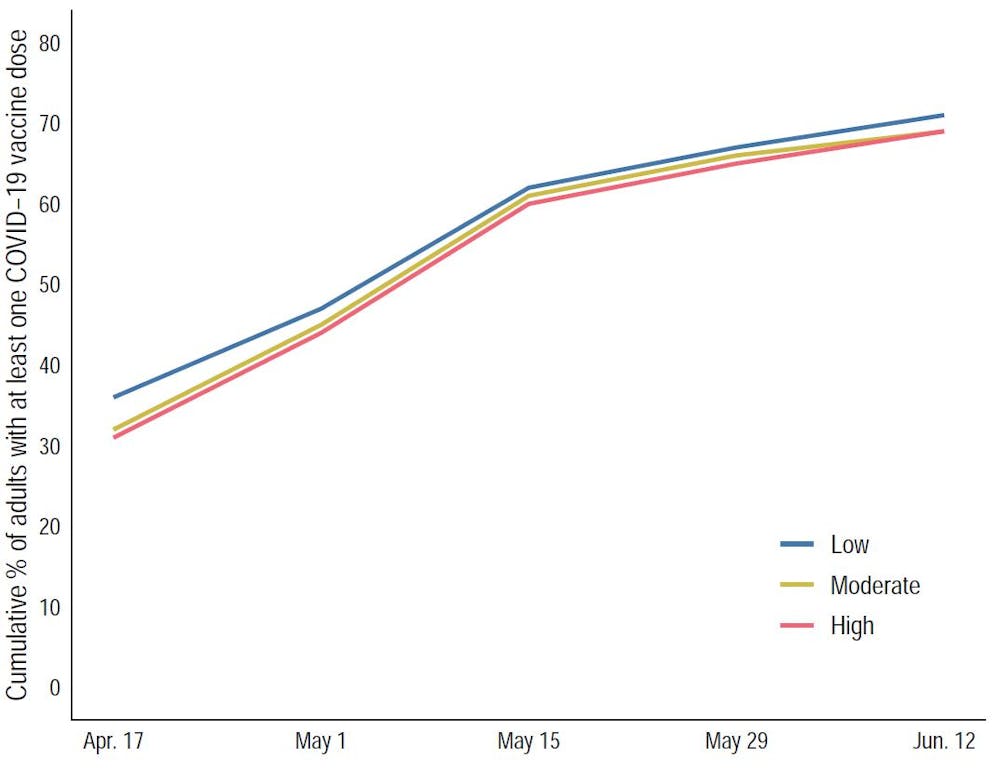
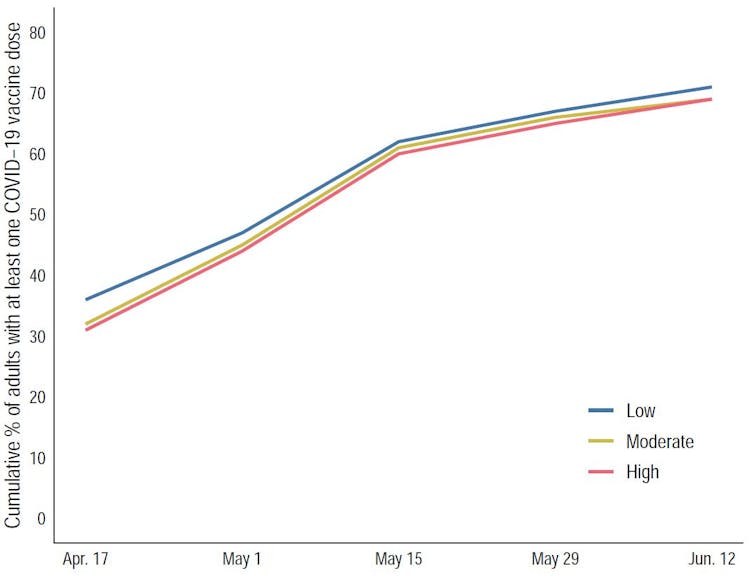
In April, neighbourhoods with a higher COVID-19 risk had lower vaccination rates than those with a lower COVID-19 risk. The average difference in COVID-19 vaccination rates was 4.4 percentage points between neighbourhoods with low and moderate COVID-19 risks, and 5.8 percentage points between neighbourhoods with low and high COVID-19 risks.
Vaccination rates increased faster in neighbourhoods with higher COVID-19 risks. (Choi/Denice), Author provided
Vaccination rates, however, grew faster in neighbourhoods with higher COVID-19 risks. By June, the average difference in vaccination rates between neighbourhoods with low and moderate COVID-19 risks was one percentage point. The corresponding difference between neighbourhoods with low and high risks of COVID-19 was 1.7 percentage points.
These findings suggest that Ontario’s policies aimed at improving vaccine equity have been effective at increasing vaccination rates in neighbourhoods hit hard by the COVID-19 pandemic.
Persistent disparities in COVID-19 rates
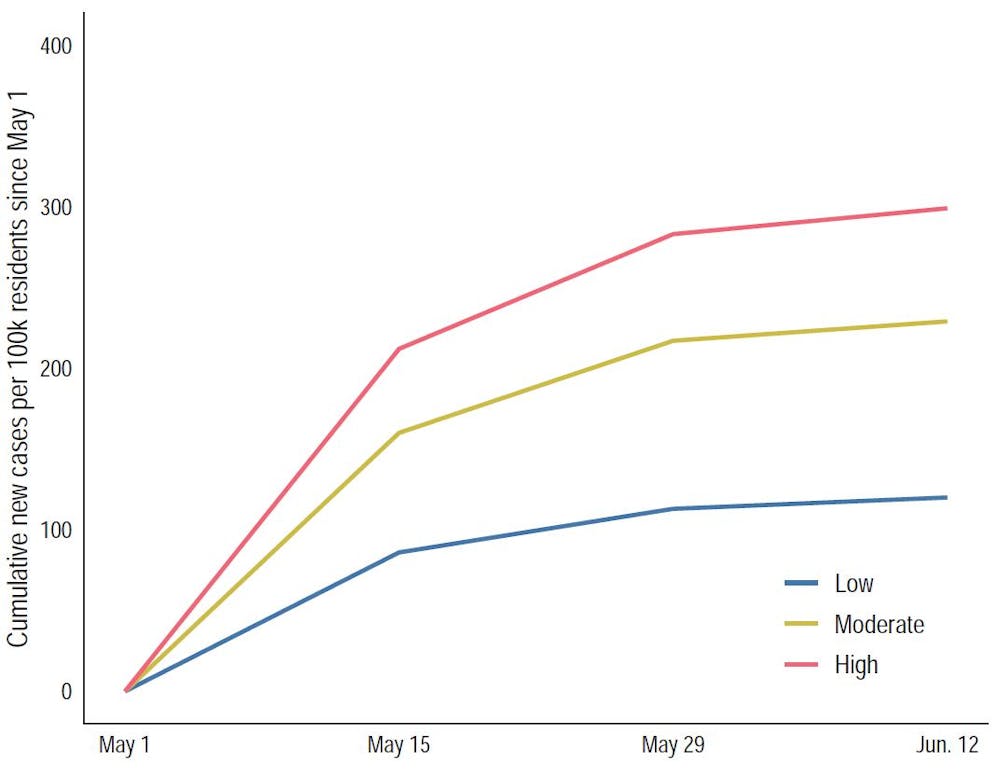
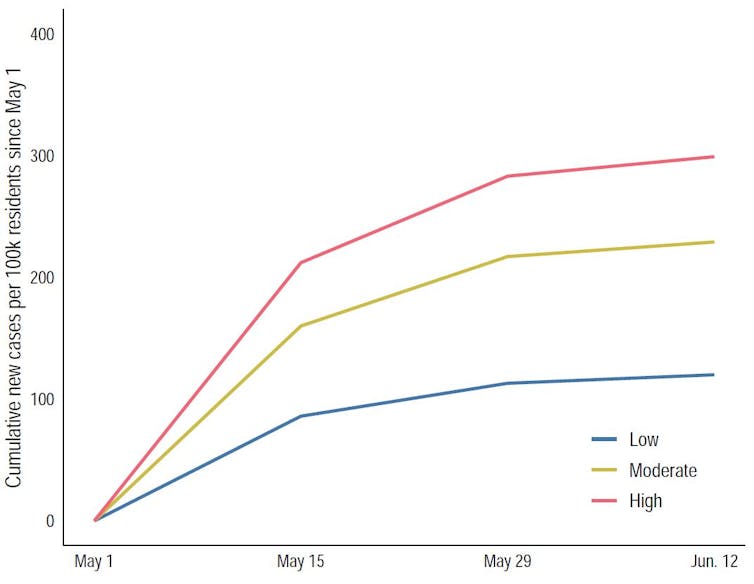
COVID-19 infections spread more slowly in neighbourhoods where vaccination rates increased quickly. Yet, COVID-19 infections continued to spread more in at-risk neighbourhoods even though vaccine rates grew faster in these communities. For example, between April and June 2021, for every 100,000 residents, neighbourhoods with a high COVID-19 risk had 421 more COVID-19 cases than low-risk neighbourhoods.
COVID-19 infections continued to spread more in at-risk neighbourhoods although vaccine rates grew faster in these communities. (Choi/Denice), Author provided
The faster spread of COVID-19 in at-risk neighbourhoods is largely attributable to the social, economic and demographic composition of these areas. Essential workers, some racial minority groups and immigrants continue to have greater exposure to the COVID-19 virus.
The overall implication is that vaccination rates in at-risk communities did not rise fast enough to counteract their higher risk of infection. This higher risk emerges from structural disadvantages that render residents of at-risk neighborhoods more vulnerable to COVID-19 infections. Our earlier research, which is also undergoing peer review, identified some of these factors as overcrowded housing and need to travel — often via public transit — for necessities like food and health care.
Our results also reveal that immigrant neighbourhoods have been left behind in Toronto’s vaccination roll-out. Not only did they have lower vaccine rates in April, but rates in these neighbourhoods also increased at a much slower pace. Lower vaccination rates and greater exposure to the COVID-19 virus may be the reason why COVID-19 spread faster in immigrant neighbourhoods.
Implications for the vaccination roll-out
In Toronto, the average vaccination rates across neighbourhoods with varying COVID-19 risks are nearly equal. In the absence of herd immunity, having the same vaccination rate in populations with different degrees of exposure to the virus will not result in the same infection rate. Under such circumstances, COVID-19 will continue to spread faster in at-risk neighbourhoods.
With the emergence of COVID-19 variants, whether or not Canada will ever achieve herd immunity is unclear. Therefore, reducing disparities in COVID-19 infections may require greater allocation of vaccine dosages and higher vaccination rates among groups at greater risk.
Greater efforts should also be made to understand and reduce the barriers to vaccine access among immigrant communities, including travel time and language barriers. Addressing these factors may hold the key for Toronto to reduce inequalities in COVID-19 rates.
Finally, vaccines should not be viewed as a silver bullet that can end the pandemic. Equitable distribution of vaccines should occur in tandem with other safety measures to slow the spread of COVID-19. Such multifaceted strategies are our best weapon against variants and our best chance at defeating the pandemic.
Do you have a question about COVID-19 vaccines? Email ca‑[email protected] and vaccine experts will answer questions in upcoming articles.Kate Choi, Associate Professor, Sociology, Western University and Patrick Denice, Assistant Professor of Sociology, Western UniversityThis article is republished from The Conversation under a Creative Commons license. Read the original article.
As a child on vacations, Eric Simard followed his father – a professional photographer – across Canada, loading film, learning how to operate equipment, acting as an assistant. He has since dipped his toe in portrait photography and weddings with success, although throughout high school, there was little uncertainty. He aspired to be a professional artist – a painter, in fact.


 Kate Choi, Associate Professor, Sociology, Western University and Patrick Denice, Assistant Professor of Sociology, Western University
This article is republished from The Conversation under a Creative Commons license. Read the original article.
Kate Choi, Associate Professor, Sociology, Western University and Patrick Denice, Assistant Professor of Sociology, Western University
This article is republished from The Conversation under a Creative Commons license. Read the original article.