


Look up at the night sky with your naked eye and it may seem like it rarely changes. Yet the universe is in constant flux. Stars drift through space, orbiting the centre of the Milky Way as planets orbit them. They rotate, showing off spots on their surfaces and sometimes producing violent outbursts that affect planetary atmospheres much like solar storms produce auroras on the Earth.
As stars age, they can die dramatically as supernovae, releasing material that will form the next generation of stars and planets.
A new NASA telescope – named after NASA’s first chief of astronomy and first female executive, Nancy Grace Roman – will let us observe these changes to the night sky, almost as if we are watching a cosmic high-definition movie.
This is thanks to three capabilities working together: sharp images, a huge field of view and repeated observations.
Watching the sky change
The Nancy Grace Roman Telescope is often described as the successor to the Hubble Space Telescope. It has the same size mirror as Hubble and also observes visible and infrared light. But it is capable of observing a much larger patch of the sky – up to 200 times larger.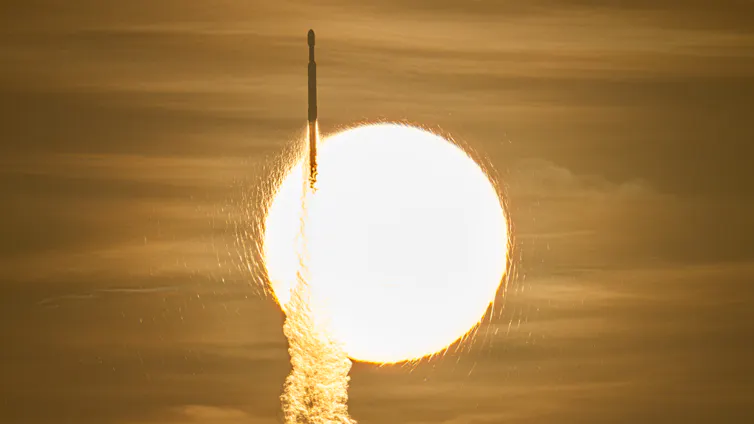

A window into the Milky Way
In the galactic bulge, thousands of stars (along with gas and dust) obscure our view of the centre of the galaxy. These same stars appear to our eyes as almost a solid white, smeary “Milky Way.” Roman, however, can see the individual stars to use them as a backdrop for interesting science. One of the primary focuses of the Galactic Bulge Time-Domain Survey is finding objects through microlensing. This is a process through which gravity from a passing object can warp and magnify light from a distant star behind it, allowing us to have a better view of that distant star. These passing foreground objects can include stars, Mars-sized planets and even black holes hundreds of times the mass of the Sun.What changing starlight reveals
Staring at stars can also reveal how stars themselves rotate and change over time. This change is particularly interesting for the very smallest and coolest stars. Along with magnetic spots, clouds are also expected on the surface of stars cooler than roughly 2,500 C. As the stars rotate, these features come in and out of view, allowing astronomers to measure their rotation periods. Comparing rotation across many targets can reveal patterns in how these stars change over broad timescales. Yet these stars are quite faint and red, making studying large numbers incredibly difficult with current surveys.
 Samantha Lambier, PhD Candidate in Astronomy, Western University
This article is republished from The Conversation under a Creative Commons license. Read the original article.
Expert Insight reflects the perspective and scholarly interest of Western faculty members and is not an articulation of official university policy on issues being addressed.
Samantha Lambier, PhD Candidate in Astronomy, Western University
This article is republished from The Conversation under a Creative Commons license. Read the original article.
Expert Insight reflects the perspective and scholarly interest of Western faculty members and is not an articulation of official university policy on issues being addressed.


